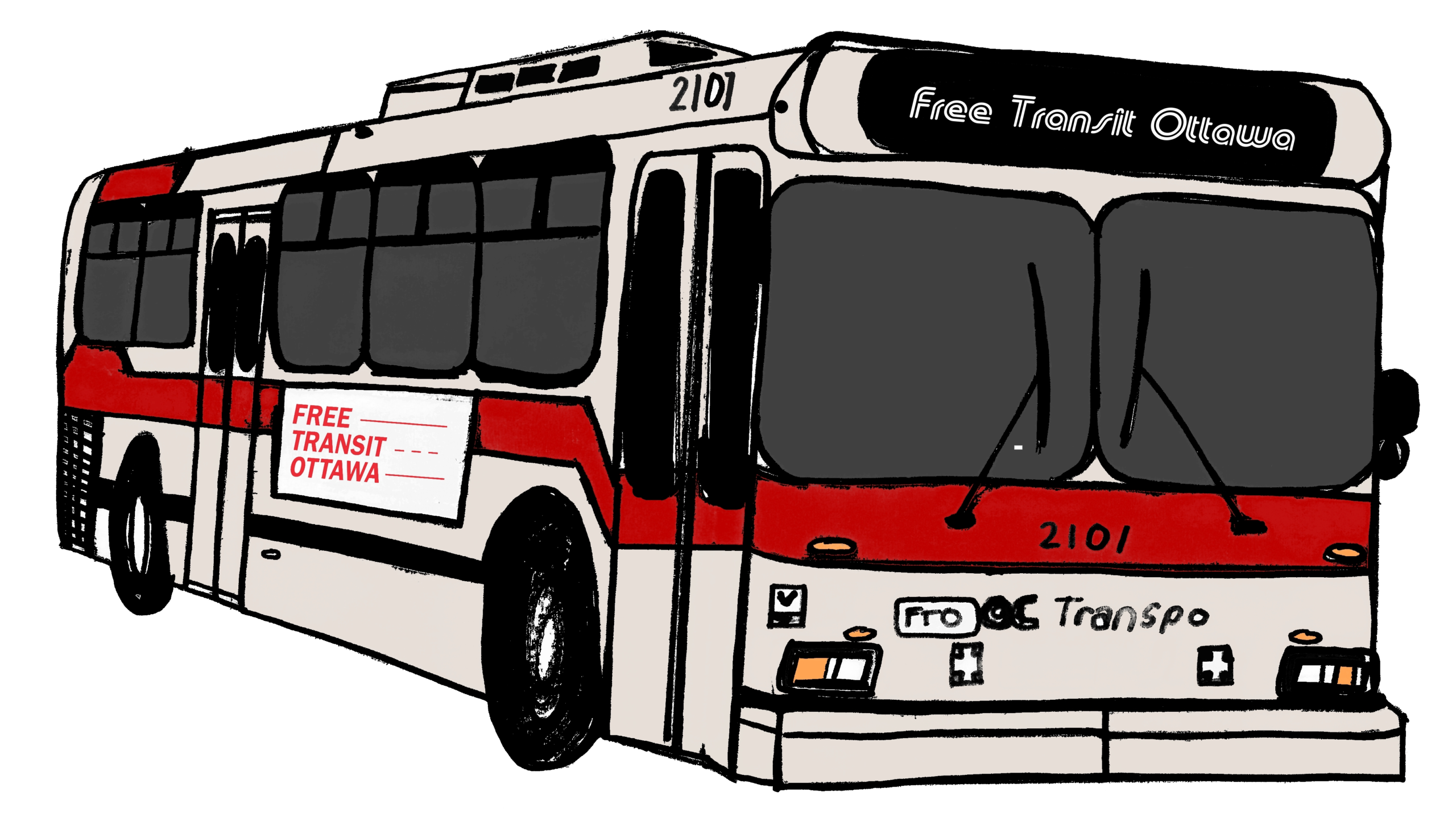
A city that neglects its transit system effectively requires people to travel by personal vehicles or ride hailing. Between gas prices, insurance, parking, maintenance, and the upfront cost of buying a vehicle, the average cost of car ownership is $16,000 a year – an incredibly expensive way to get around.
As far as Free Transit Ottawa is concerned, transit should be funded by the federal and provincial governments largely through corporate and wealth taxes. But we don’t have to wait for a federal government prepared to act. If it had the political will, the City of Ottawa could find the money to eliminate most fares and make the service more attractive to the people of Ottawa – without raising property taxes.
In total, the cost of implementing our six demands for more reliable, affordable, and convenient bus service would be $125M a year:
- Free transit during off-peak hours – $50 M1
- 150 electric buses – $52.5 M2
- 50 neighbourhood buses – $13 M3
- 25 ParaTranspo buses – $6.5M4
- Expanding bus-only lanes – $2.55 M5
- Election of 4 Citizen Transit Commissioners – $250,0006
There are various ways to finance these improvements without an increase in property taxes and our approach centres on ‘progressive’ measures that also discourage the use of private cars.
- $50 M – Reallocate funds budgeted for road widening7 to transit
- $10 M – Raise parking rates to $6.00/hr (including Sundays and expanding paid parking to all commercial areas)8
- $15 M – Increase Uber/Lyft accessibility surcharge from $0.10 per ride to $0.50 per ride9
- $21 M – Increase development charges on single-family dwellings by 25%10
- $14 M – Eliminate Main Streets and Brownfield Site tax rebates11
- $15 M – Savings from adopting bus-only lanes12
- Annual Fare Revenue is roughly $140M. The off-peak portion was calculated from figures in the Arcadis Transportation Trends Final Report to City of Ottawa May 30 2024. This figure coincides with the typical estimate of the share of revenue derived from off peak hours. Figures assume that the division of riders with discounted fares between peak and off peak hours is the same as that of ‘full fare’ riders.
↩︎ - In addition to what OC Transpo already plans on ordering. Figures are based on City of Ottawa data regarding purchase cost and lifespan of electric buses, expected operating costs, including operator wages & benefits @ 75 hours/week for 52 weeks. Wage data provided by ATU Local 279.
↩︎ - Figures are based on the upper end cost ($120,000) of a 20 passenger diesel vehicle with a life of 12 years (although many last 20). Fuel ($50,000) is calculated at two-thirds that of a regular bus operating 75/hrs week. Annual cost of repairs ($2,500) is assumed to be the same as that for a regular diesel bus. Annual operator costs are the same as for a regular bus operated for 75 hours/wk. ↩︎
- Cost estimates assumes the use of the same type of vehicles as in previous endnote. ↩︎
- Creating bus only lanes can involve as little as painting lane markings but roadwork can be required in other cases. ↩︎
- Figure assumes election is part of the regular Municipal elections and for a 4 year term. ↩︎
- The City Capital Budget allocates an average of $50 M annually over the next several years to widen 2 lane roads to 4. This would be diverted to funding transit. ↩︎
- Ottawa collected $18.04 M in parking revenue in 2024. Hourly rates vary but average about $4.00. A 50% increase to $6.00, still comparatively low, should raise an additional $9 M; extending the scope of paid parking as indicated would generate at least an additional $1M. ↩︎
- Ride-Hailing services pay a ‘surcharge’ in lieu of providing an accessible service. In 2017, the $0.07 per ride charge managed to generate $1.2 million. (It is now $0.10 per ride but no details on the revenue to the City have been released since). Since 2017, ride-sharing services have grown dramatically, with Uber’s world-wide revenues, for example, growing to roughly 4.5 times the 2017 levels. We conservatively estimate that use in Ottawa of ride-sharing services has doubled. Raising the value of the surcharge from $0.10/ride to $0.50, would generate at least $17 million or a $15 million increase on the City’s current revenue. ↩︎
- Development charges on a Single Family Dwelling (SFD) were $34,000 inside the Greeenbelt and $40,000 outside. SFDs were 26.4% of all new starts (9,200) or 2,400. City Revenue from Development Charges on new SFDs is $35,000 x 2,400 or $84 M. A 25% increase in Development Charges would generate $21M in additional revenue. This would add $8,500 to the cost of a SFD inside the Greenbelt and $10,000 to a SFD outside the Greenbelt. ↩︎
- Eliminating the tax rebate on Brownfield developments and the Main streets programs could add $14 million. There is no evidence suggesting that these grants, which have been averaging $7 M per year, actually have an impact on the location of real estate development. ↩︎
- A report from Vancouver’s TransLink found that 15% of bus operating costs are attributable to traffic delays. Some Ottawa bus routes are on 2-lane streets unsuitable for bus only lanes so we believe 2.5% or $15M is a conservative estimate of the savings. ↩︎